
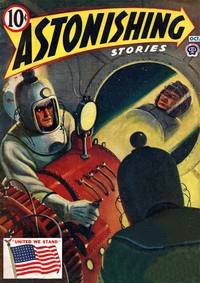
Doomsday on Ajiat by Neil R. Jones
Let's set the scene. It's the 1930s. Pulp magazines are king, and Neil R. Jones is dreaming up a future where humanity is long gone, replaced by immortal machine-men. Our guide is Professor Jameson, a 20th-century scientist whose brain now lives in a robotic body. He travels the galaxy with a crew of similar beings, the Zoromes, exploring strange new worlds.
The Story
Their latest stop is Ajiat. At first, it seems like a paradise. But they quickly learn the whole civilization lives under a shadow. For generations, the people have believed their sun is on the verge of a catastrophic explosion. This 'doomsday' prophecy dictates everything—how they live, work, and obey. The ruling class, the Scientists, maintain absolute power by managing this fear. They've even built a giant, mysterious 'Doomsday Dome.' Jameson and his metal comrades have to figure out the truth. Is the sun really about to die? Or is this an elaborate, centuries-long lie to keep the population in check? The story becomes a tense investigation, pitting unfeeling logic and advanced science against deep-rooted faith and manipulation.
Why You Should Read It
What grabbed me wasn't the ray guns or robots (though those are fun), but the core idea. Jones wrote this during the Great Depression, and you can feel it. The book is really about control through fear and what happens when an entire society is built on a promised catastrophe. Professor Jameson is a fascinating hero because he's utterly logical, a detached observer in a world ruled by emotion. Watching him try to break through the brainwashing is the best part. The plot moves fast, and the mystery of the Dome is genuinely compelling. It's not a deep character study; it's a propulsive idea rocket.
Final Verdict
This is a perfect read for fans of classic science fiction who love big concepts. Think of it as a great-grandparent to stories like 'The Matrix' or 'Logan's Run,' where the system is the villain. It's also ideal if you enjoy digging into the roots of the genre and seeing where modern tropes came from. The prose is straightforward and the action is clear, making it a quick, satisfying adventure. Just be ready for that distinct 1930s flavor—it's part of the charm. If you pick it up, you're not just reading a story; you're holding a piece of sci-fi history.
This content is free to share and distribute. Preserving history for future generations.
Barbara Perez
1 year agoI started reading this with a critical mind, the critical analysis of current industry standards is very timely. I feel much more confident in my knowledge after finishing this.
Linda Perez
6 months agoI started reading this with a critical mind, the author clearly has a deep mastery of the subject matter. Highly recommended for those seeking credible information.
Emily Thomas
1 month agoIt’s rare to find such a well-structured narrative nowadays, the language used is precise without being overly academic or confusing. I appreciate the effort that went into this curation.
Elizabeth Williams
8 months agoRight from the opening paragraph, it manages to maintain a consistent flow even when discussing difficult topics. A mandatory read for anyone in this industry.








William Gonzalez
8 months agoI decided to give this a try based on a colleague's recommendation, the chapter on advanced strategies offers insights I haven't seen elsewhere. I feel much more confident in my knowledge after finishing this.