
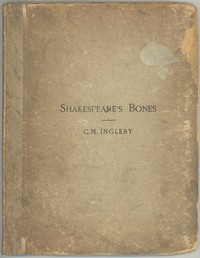
Shakespeare's Bones by C. M. Ingleby
First published in 1883, 'Shakespeare's Bones' isn't a novel or a biography. It's something much stranger: a polemical pamphlet born from a real-life Victorian controversy. The core of the story is simple. A group had formally proposed to open Shakespeare's grave in Holy Trinity Church, Stratford-upon-Avon. Their reasons ranged from scientific curiosity (studying his skull) to verifying the accuracy of the famous memorial bust.
The Story
C.M. Ingleby, a respected Shakespeare scholar, gets wind of this plan and is horrified. He writes this entire book to argue against it. He marches through every reason he can think of. He questions the legal right anyone has to disturb the grave. He attacks the supposed scientific value, pointing out how phrenology (the skull-reading science of the day) was shaky at best. But his biggest weapon is the emotional and moral appeal. He argues passionately for the sanctity of the grave, asking if we would dare do this to our own ancestors. And, of course, he brings up the chilling curse inscribed on the Bard's tomb: 'Blessed be the man that spares these stones, And cursed be he that moves my bones.' Ingleby uses that curse not as superstition, but as a clear expression of Shakespeare's own wished-for rest.
Why You Should Read It
What makes this little book so compelling is Ingleby's voice. He's not a detached academic here; he's a fan, a protector, and he's genuinely upset. Reading it feels like listening to a smart, slightly exasperated friend explain why a popular idea is actually terrible. It gives you a direct line into Victorian thinking—their reverence for Shakespeare, their budding scientific curiosity, and their debates about ethics. It's also weirdly timeless. We still argue today about how far we should go in the name of research or historical inquiry. Ingleby's core question—'Just because we *can*, does it mean we *should*?'—resonates loudly.
Final Verdict
This is a perfect bite-sized read for anyone who loves odd corners of history, Shakespeare lore, or historical true crime adjacent stories without the crime. It's for the reader who enjoys primary sources that crackle with personality. You won't get a life story of Shakespeare, but you'll get a fiercely opinionated, 140-year-old defense of his final resting place. It’s a fascinating artifact that proves some debates about how we treat the past are never really settled.
This book is widely considered to be in the public domain. It is available for public use and education.
Sarah Moore
6 months agoHaving read the author's previous works, the critical analysis of current industry standards is very timely. A mandatory read for anyone in this industry.
Kimberly Miller
1 year agoI was skeptical about the depth of this book at first, but the inclusion of diverse viewpoints strengthens the overall narrative. A mandatory read for anyone in this industry.
Andrew Flores
9 months agoGreat read!
Elijah Scott
8 months agoGreat read!




Ashley Anderson
10 months agoThe analytical framework presented is both innovative and robust.