
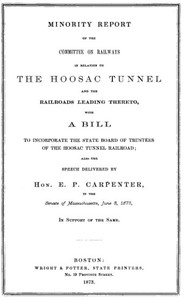
Minority Report of the Committee on Railways in Relation to the Hoosac Tunnel…
Let’s set the scene: Massachusetts, the 1860s. The state is bankrolling one of the most ambitious engineering projects of its time—the Hoosac Tunnel. The goal is to blast a railroad route straight through the Berkshire Mountains, a tunnel over five miles long. It was supposed to take a couple of years and a few million dollars.
The Story
This book isn't a novel; it's a government document, but the story it tells is clear. The project is a mess. It’s been dragging on for over a decade, swallowing up tax money with little to show for it. Workers are getting killed in cave-ins and nitroglycerin explosions. Costs are ballooning out of control. A special committee is formed to investigate. The majority of the committee writes a report that, while noting some problems, largely defends the project and its management.
This 'Minority Report' is the blistering rebuttal. Written by a single committee member, it rejects the whitewash. Page after page, it itemizes the failures: flawed contracts, incompetent oversight, dangerous working conditions, and financial shell games. It names names and points fingers. It’s the account of someone inside the system who looked at the official story and said, 'This isn't just wrong; it's a dangerous lie.'
Why You Should Read It
You should read it because it feels startlingly current. The frustration in the writing is palpable. This isn't a calm historical analysis written a century later. This is someone in the middle of the scandal, trying to shout over the noise of political and financial interests. The themes are timeless: government waste, the conflict between public good and private profit, and the courage (or stubbornness) it takes to stand alone against a powerful narrative. The 'character' here is the author—an anonymous bureaucrat whose sheer indignation gives the document a fiery, human heart.
Final Verdict
This is not for everyone. If you want a traditional narrative with characters and plot twists, look elsewhere. But if you’re fascinated by real-life political drama, infrastructure stories, or the messy truth behind historical progress, this is a hidden gem. It’s perfect for history buffs who like primary sources, policy wonks who enjoy a good case study in failure, and anyone who appreciates a beautifully written piece of protest. Think of it as the 1860s version of a whistleblower’s testimony, and it’s just as compelling.
The copyright for this book has expired, making it public property. Use this text in your own projects freely.
Nancy Perez
4 months agoIt took me a while to process the complex ideas here, but the author clearly has a deep mastery of the subject matter. This exceeded my expectations in almost every way.
Matthew Thomas
2 months agoUnlike many other resources I've purchased before, the transition between theoretical knowledge and practical application is seamless. If you want to master this topic, start right here.
Barbara Jones
5 months agoI've been looking for a reliable source on this topic, and the way it handles controversial points with balance is quite professional. Thanks for making such a high-quality version available.
Thomas Perez
11 months agoAfter a thorough walkthrough of the table of contents, the wealth of information provided exceeds the average market standard. A rare gem in a sea of mediocre content.






Susan White
1 year agoExactly what I was looking for, thanks!