
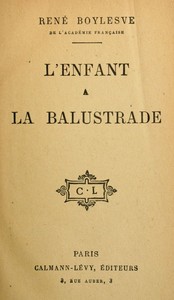
L'enfant à la balustrade by René Boylesve
René Boylesve's L'enfant à la balustrade (The Child at the Balustrade) is a delicate, almost whispered novel from 1900 that captures a feeling many of us know but rarely see in stories of its time.
The Story
The plot is simple on the surface. We follow a sensitive, observant boy growing up in a strict, traditional French provincial setting. Life is all about rules, expectations, and knowing your place. His family and society have a clear plan for him: follow the path laid out, be respectable, and don't make waves. But the boy feels different. From his perch—often literally at a balcony railing (the 'balustrade')—he watches the world, feeling separate from it. The conflict isn't with a villain, but with the entire invisible weight of social conformity. The story is his internal journey as he grapples with this disconnect, trying to understand himself in a world that wants him to be something else.
Why You Should Read It
This book surprised me with its modern heart. Boylesve writes about inner life with a gentle precision that feels very real. He gets the small moments—the awkward family dinner, the pressure of a neighbor's glance, the longing you can't quite explain. The boy isn't a rebel shouting from the rooftops; he's confused, quiet, and deeply feeling. That's what makes him so relatable. The writing is beautiful without being flowery, painting the town and its atmosphere so you can almost smell the dust and hear the quiet. It's a slow, reflective read, perfect for when you want to step out of a noisy world and into a thoughtful, character-driven space.
Final Verdict
This isn't a book for someone craving fast-paced action or a twisty plot. It's for readers who love getting inside a character's mind and for anyone who has ever felt like an outsider in their own environment. If you enjoy authors like Marcel Proust or Émile Zola but want something more intimate and less sprawling, Boylesve is a fantastic find. L'enfant à la balustrade is a quiet masterpiece about the universal search for self, and it remains movingly relevant over a century later.
This publication is available for unrestricted use. You are welcome to share this with anyone.
John Johnson
3 months agoThe clarity of the concluding remarks is very professional.
Christopher Jackson
11 months agoAs a long-time follower of this subject matter, the nuanced approach to the central theme was better than I expected. Well worth the time invested in reading it.
Jennifer Harris
2 months agoImpressive quality for a digital edition.
David Brown
3 months agoThis was exactly the kind of deep dive I was searching for, the insights into future trends are particularly thought-provoking. Well worth the time invested in reading it.





Robert Garcia
11 months agoI started reading this with a critical mind, the author doesn't just scratch the surface but goes into meaningful detail. I am looking forward to the author's next publication.