
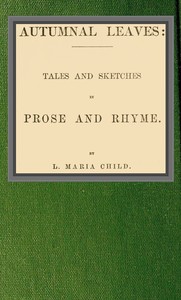
Autumnal leaves: tales and sketches in prose and rhyme by Lydia Maria Child
Let's be clear from the start: 'Autumnal Leaves' is not a novel. Don't go in expecting a single plot that unfolds over 300 pages. Think of it instead as a personal scrapbook, a collection of Lydia Maria Child's thoughts and imaginings from the 1840s. It's a mix of short stories, character sketches, poems, and reflective essays. One piece might be a gentle poem about nature's beauty, and the next could be a pointed story about social injustice or a flawed character learning a hard lesson.
The Story
There isn't one story, but many. The book moves like the season it's named for—sometimes bright and golden, sometimes thoughtful and somber. You'll meet a variety of characters: young lovers, wise elders, struggling farmers, and people confronting moral dilemmas. The settings shift from cozy New England hearths to broader philosophical landscapes. The "plot" is the journey through Child's mind—her observations on human nature, her love for the natural world, and her unwavering concern for a fair and compassionate society. It's less about what happens next and more about the feeling each piece leaves you with.
Why You Should Read It
This book surprised me. I knew Lydia Maria Child as a powerhouse reformer, a writer who fought fiercely against slavery. 'Autumnal Leaves' shows another side of her. Yes, her moral compass is always present, but so is her eye for everyday beauty. Her descriptions of a forest or a childhood memory are so vivid and tender. It makes her activism feel more grounded, more human. She wasn't just arguing from a podium; she was fighting for a world where simple, good moments could exist for everyone. Reading this collection feels intimate, like you're getting to know the whole person, not just the public figure. The language is old-fashioned, of course, but the heart behind it feels immediate and genuine.
Final Verdict
This is a book for a specific mood. It's perfect for a quiet afternoon, for readers who love history and want to feel connected to the past in a personal way. If you're fascinated by 19th-century American thought, or if you enjoy collections that let you dip in and out, you'll find a lot here. It's also great for anyone who appreciates writing that finds the profound in the simple. It's not a page-turner in the traditional sense, but it is a deeply rewarding and thoughtful companion.
No rights are reserved for this publication. You are welcome to share this with anyone.
Richard Miller
8 months agoFinally found a version that is easy on the eyes.
Robert Smith
9 months agoIt’s rare to find such a well-structured narrative nowadays, the author clearly has a deep mastery of the subject matter. Truly a masterpiece of digital educational material.
Barbara Johnson
3 months agoI found the data interpretation to be highly professional and unbiased.
Dorothy Torres
6 months agoFinally found time to read this!

Joseph Smith
1 year agoFrom a researcher's perspective, the case studies and practical examples provided add immense value. It definitely lives up to the reputation of the publisher.