
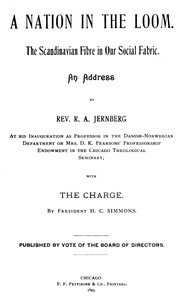
A Nation in the Loom: The Scandinavian Fibre in Our Social Fabric by R. A. Jernberg
Ever wondered why we have jury trials, or where the idea of a town hall meeting came from? A Nation in the Loom tries to connect those dots, leading all the way back to the fjords and forests of ancient Scandinavia. R. A. Jernberg isn't just listing Viking raids; he's tracking an idea. He argues that a specific set of values—things like local self-government, public assemblies for decision-making, and a deep-seated concept of personal rights and responsibilities—formed a cultural 'fibre' that proved incredibly durable and adaptable.
The Story
There isn't a traditional plot with characters, but there is a compelling narrative thread. Jernberg acts as a guide, showing how these Scandinavian social structures survived the end of the Viking Age. He follows their path as they were carried by Norse settlers to places like Normandy and England. From there, he traces how these ideas were baked into English common law and political tradition. The final act of his story shows how these very traditions crossed the Atlantic with early American colonists, fundamentally shaping the founding principles of the United States. The 'story' is the journey of an idea across a thousand years and thousands of miles.
Why You Should Read It
What grabbed me was how it makes history feel immediate. You start seeing the echoes Jernberg talks about everywhere. That neighborhood association meeting? It has roots in a Scandinavian 'Thing.' Our belief that authority should have limits? He links it back to old Nordic concepts of law. It's not a dry history lesson; it's a series of 'aha!' moments that change how you see everyday civic life. Jernberg writes with a quiet conviction that's infectious. He's not shouting a radical theory; he's patiently laying out a trail of evidence, inviting you to see the pattern for yourself.
Final Verdict
This is a book for the curious. It's perfect for anyone who loves history but prefers big, connecting ideas over just dates and battles. If you've ever enjoyed books like Guns, Germs, and Steel that look for the deep roots of our world, you'll find a kindred spirit in Jernberg. It's also a fantastic read for Americans or Brits interested in the 'why' behind their political instincts. Fair warning: it was written in 1912, so the prose is clear but formal in places—think of it as a thoughtful, extended conversation with a brilliant, old-school professor. It’s a hidden gem that offers a surprisingly relevant look at where we come from.
This publication is available for unrestricted use. You do not need permission to reproduce this work.
Barbara Gonzalez
1 year agoIt’s rare to find such a well-structured narrative nowadays, the structural organization allows for quick referencing of key points. It cleared up a lot of the confusion I had previously.
Margaret Hernandez
1 year agoImpressive quality for a digital edition.
Margaret Brown
2 years agoMy first impression was quite positive because the argument presented in the middle section is particularly compelling. The price-to-value ratio here is simply unbeatable.
John Moore
5 months agoRight from the opening paragraph, the wealth of information provided exceeds the average market standard. A perfect balance of theory and practical advice.








William Taylor
11 months agoThis digital copy caught my eye due to its reputation, it manages to maintain a consistent flow even when discussing difficult topics. Truly a masterpiece of digital educational material.