About 74 minutes
The Tale of Jasper Jay Tuck-Me-In Tales — Text and Context
Childrens Adventures
16,936 recorded words. 1 minutes difference from this book's estimate.
View Gutenberg source #21836
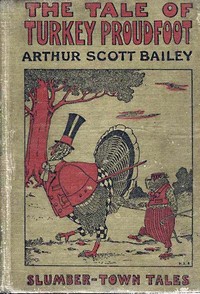
The Tale of Turkey Proudfoot Slumber-Town Tales — Text and Context can be approached with a clearer sense of reading commitment from its source measurements: 17,164 words, 1 hr 15 min estimated reading time, and 3 detected text sections.
The text analysis averages about 11.4 words per sentence, while the detected sections provide another way to judge how the source is divided.
Project Gutenberg metadata also associates the work with “Animals -- Juvenile fiction,” connecting these edition facts with the source record’s subject description.
Explore this collection
These alternatives are selected using recorded categories and estimated reading time.
About 74 minutes
Childrens Adventures
16,936 recorded words. 1 minutes difference from this book's estimate.
View Gutenberg source #21836About 73 minutes
Childrens Adventures
16,778 recorded words. 2 minutes difference from this book's estimate.
View Gutenberg source #10220About 72 minutes
Childrens Adventures
16,499 recorded words. 3 minutes difference from this book's estimate.
View Gutenberg source #21322Search stored excerpts and compare books → Choose by your preferences →
Choices use stored catalog measurements. Estimates vary with reading speed. A shared category is a catalog label, not a claim that two books have the same argument or literary quality.
Search reads excerpt text stored with this catalog and links to its associated Gutenberg record. The connection is stored in the site database; this tool does not recheck that every excerpt is word-for-word identical to that external record. Excerpt search does not cover every chapter and does not verify historical publication dates.
Catalog snapshot checked: 2026-09-26. Coverage: 91 public books, 91 available source excerpts.
Calculated from edition completeness, EPUB availability, text structure and catalogue metadata. Not a user rating.
Total of 100 points, scaled to a 2.5-5.0 range. Editions with an empty description or a missing EPUB file are not scored.
Public-domain source text
The source text is kept in the dedicated reader, separate from this catalogue record and its commentary.
From the first chapter, Arthur Scott Bailey establishes Turkey Proudfoot’s character through a single, repeated action: strutting. The hen turkeys admire his “beautiful tail” and “greenish, coppery, bronzy glitter,” while the rest of the farmyard calls him “silly, vain, noisy and quarrelsome.” This split perspective—admiration versus irritation—drives the narrative structure. Bailey moves Turkey Proudfoot between three distinct settings: the farmyard, the pasture, and the woods. Each shift in location introduces a new rival or lesson, and the bird’s reactions are consistently physical: he raises his foot high, gobbles loudly, or, when threatened, retreats to a safe perch. The story’s rhythm depends on these movements, and the excerpts show how Bailey uses setting to test Turkey Proudfoot’s pride.
Turkey Proudfoot’s strutting is not merely a personality trait; it organizes the narrative. The opening chapter describes his walk: “At every step he took he raised a foot high in the air, acting for all the world as if the ground wasn’t good enough for him to walk upon.” This gesture recurs whenever he feels superior. When he encounters the peacock, however, his strutting stops. The peacock’s “great tail rising above him” and “frightfully loud, harsh voice” make Turkey Proudfoot “stand in great awe.” Bailey contrasts the two birds’ displays: the peacock’s tail is larger, his voice harsher, and Turkey Proudfoot’s usual postures fail. The strutting motif thus marks his status, and its absence signals a shift in power. Later, after Mrs. Wren’s advice, Turkey Proudfoot declares he will parade behind the farmhouse instead, showing that strutting adapts to territory but the impulse remains.
Bailey uses gobbling to mark boundaries and provoke conflict. Turkey Proudfoot’s “Gobble, gobble, gobble!” pleases the hen turkeys but annoys everyone else. The sound is described as “noise” that people wish he would make “off by himself.” When the peacock arrives, his “rasping scream” replaces Turkey Proudfoot’s gobbles as the dominant sound. Rusty Wren complains that the peacock’s “terrible squalls will disturb everybody in the valley.” Turkey Proudfoot initially feels threatened, but after overhearing Mrs. Wren, he claims his own gobble is “much more beautiful” than the peacock’s voice. The gobbling thus becomes a measure of self-worth. Bailey also links gobbling to daily routines: Turkey Proudfoot indulges in “early morning gobbles” until the peacock’s scream interrupts. The soundscape of the farm changes with each new arrival, and Turkey Proudfoot’s vocal responses reveal his attempts to reassert control.
Turkey Proudfoot’s excursions beyond the farmyard introduce new challenges. In chapter XVI, he wanders into the woods and discovers a beech tree, enjoying nuts until a “thump-thump-thump” startles him. He mistakes the sound for Johnnie Green drumming, but the excerpt suggests it might be a grouse—a wild bird that drums on a log. This scene shifts the story from domestic rivalries to encounters with wild creatures. The woods are described as “beyond the pasture fence,” a boundary Turkey Proudfoot crosses when he feels bold. Earlier, he roosts in a tree near the farmhouse after his defeat by the peacock, showing that his roosting spots reflect his mood. Bailey uses these movements to vary the setting and introduce new sounds and behaviors. The woods offer nuts and freedom, but also unknown threats, contrasting with the familiar farmyard where Turkey Proudfoot is both admired and mocked.
Bailey repeatedly emphasizes verticality: tails that stick up, perches that are high, and voices that carry. Turkey Proudfoot’s tail is described as “huge” and “shining,” and he spreads it to impress. The peacock’s tail “sticks up higher,” and he stands “on top of the wall,” making him appear larger. Mrs. Wren mocks this obsession: “How absurd to be proud like Turkey Proudfoot, just because your tail happens to stick up in the air.” She notes that her own tail and her husband’s also stick up, but they don’t boast. This image recurs when Turkey Proudfoot roosts in a tree, seeking a high perch for safety. After the peacock’s arrival, he chooses a tree “near the farmhouse,” while the peacock sleeps “in another tree not far away, even nearer.” Height becomes a measure of status and security. Bailey uses these vertical details to reinforce the theme of pride: the higher the tail or perch, the greater the fall—or the louder the gobble.
Readers may find it useful to track Turkey Proudfoot’s physical position in each chapter—whether he is strutting in the farmyard, roosting in a tree, or foraging in the woods. Bailey’s structure depends on these shifts, and each new setting brings a fresh test of the bird’s vanity. The story rewards attention to sounds and postures, as they often foreshadow a change in Turkey Proudfoot’s fortunes. The excerpts suggest a pattern of challenge, retreat, and partial reform, but the complete book may reveal whether he ever truly learns from Mrs. Wren’s advice.
Reading about Turkey Proudfoot’s strutting pride and his careful woodland negotiations, I found myself missing the quiet, watchful tone of a different journey—one where girls measure their courage against the White Mountains. It’s curious how a farmyard tale can echo a mountain adventure. Both hold that simple pleasure of place shaping character. The Meadow-Brook Girls in the Hills; Or, The Missing Pilot of the White Mountains — A Reader’s Guide lingered beside it in my mind, like an old acquaintance met again.
Build a private reading journal entry for this title.









