About 73 minutes
Daddy Takes Us Skating — Context and Discussion
Childrens Adventures
16,778 recorded words. 1 minutes difference from this book's estimate.
View Gutenberg source #10220
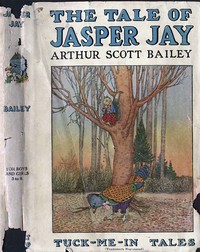
The source record for The Tale of Jasper Jay Tuck-Me-In Tales — Text and Context measures this digital text at 16,936 words, 1 hr 14 min estimated reading time, and 2 detected text sections.
The text analysis averages about 13.7 words per sentence, while the detected sections provide another way to judge how the source is divided.
Project Gutenberg metadata also associates the work with “Animals -- Juvenile fiction,” connecting these edition facts with the source record’s subject description.
Explore this collection
These alternatives are selected using recorded categories and estimated reading time.
About 73 minutes
Childrens Adventures
16,778 recorded words. 1 minutes difference from this book's estimate.
View Gutenberg source #10220About 75 minutes
Childrens Adventures
17,164 recorded words. 1 minutes difference from this book's estimate.
View Gutenberg source #21844About 72 minutes
Childrens Adventures
16,499 recorded words. 2 minutes difference from this book's estimate.
View Gutenberg source #21322Search stored excerpts and compare books → Choose by your preferences →
Choices use stored catalog measurements. Estimates vary with reading speed. A shared category is a catalog label, not a claim that two books have the same argument or literary quality.
Search reads excerpt text stored with this catalog and links to its associated Gutenberg record. The connection is stored in the site database; this tool does not recheck that every excerpt is word-for-word identical to that external record. Excerpt search does not cover every chapter and does not verify historical publication dates.
Catalog snapshot checked: 2026-09-26. Coverage: 91 public books, 91 available source excerpts.
Calculated from edition completeness, EPUB availability, text structure and catalogue metadata. Not a user rating.
Total of 100 points, scaled to a 2.5-5.0 range. Editions with an empty description or a missing EPUB file are not scored.
Public-domain source text
The source text is kept in the dedicated reader, separate from this catalogue record and its commentary.
The first chapter of The Tale of Jasper Jay immediately establishes its title character as a "bold rowdy—but handsome," a description that sets the tone for the entire book. Unlike the merely noisy old Mr. Crow, Jasper Jay is defined by his deliberate mischief: he shrieks "Jay! jay!" on frosty mornings, teases the farm cat, and steals eggs in summer. Yet Farmer Green admits there is "something about him that I can't help liking," a sentiment that complicates the reader's judgment from the start.
The excerpts reveal a structure that alternates between Jasper's roguish exploits and the reactions of other valley residents. By Chapter XIII, Buddy Brown-Thrasher has had enough of Jasper interrupting his evening songs, and the narrative shifts toward a conflict that will test Jasper's character. The reader is positioned to observe both Jasper's unapologetic rudeness and the quieter, more thoughtful response of his victims.
The opening chapter wastes no time in painting Jasper Jay as a creature of sound and motion. His "ear-splitting" call rings out even in winter, when he visits the corn-crib or teases the cat. The text emphasizes his physical appearance—"his bright blue suit"—and his skill at opening nuts with his strong bill. These details ground his personality in observable behavior rather than abstract description.
Farmer Green's comparison of Jasper to a bad boy introduces a humanizing note: the bird is mischievous and destructive, but also somehow likeable. This duality is reinforced by Johnnie Green's observation that Jasper steals eggs, which his father acknowledges without condemning. The chapter thus sets up a moral ambiguity that runs through the book: Jasper is a rogue, but not a villain.
By Chapter XIII, Jasper's antagonism toward other birds has become a central theme. He dislikes sweet songs and boasts that he prefers "a good, loud, jarring call." His method of disruption is consistent: he perches nearby and makes as much noise as possible during forest concerts. The text specifies that he targets Buddy Brown-Thrasher's evening song, interrupting it with harsh cries and laughter.
Buddy's reaction is notably restrained. He "never once thought of fighting" and instead puts on his "thinking-cap." This contrast between Jasper's aggressive noise and Buddy's thoughtful planning creates a clear opposition. The excerpts show that Buddy understands reasoning with Jasper is futile, so he seeks a different approach—one that will teach Jasper "better manners" without violence.
In Chapter XIV, Buddy Brown-Thrasher begins to act. When other birds ask if he intends to fight, he replies, "I think I can find a better way than that." The narrative withholds his plan, building suspense. The reader knows only that Buddy is "bright and early" the next morning, suggesting a deliberate, patient scheme.
This section marks a shift from Jasper's perspective to Buddy's. The earlier chapters focused on Jasper's actions and Farmer Green's commentary; now the story follows a victim's point of view. The change invites readers to consider how problems can be solved without confrontation. Buddy's method—whatever it is—promises to be clever rather than forceful, aligning with the book's gentle moral tone.
Bailey's prose relies on repeated phrases and direct characterization. Jasper is called a "rogue" multiple times, and his call "Jay! jay!" appears as a refrain. The narrator often uses the word "naturally" to introduce Jasper's justifications, as in "Naturally, that was only his way of looking at such matters." This technique subtly undercuts Jasper's self-righteousness without explicit judgment.
The dialogue is sparse but effective. Farmer Green's line "He reminds me of a bad boy" and Jasper's claim that soft notes are "all nonsense" reveal character through speech. The excerpts also show a pattern: Jasper's mischief is described in concrete actions (stealing corn, interrupting songs), while the responses of other animals are more reflective. This contrast drives the narrative forward.
As you read The Tale of Jasper Jay, pay attention to how Bailey uses sound—both Jasper's harsh calls and the songs he disrupts—to define character and conflict. Notice also the recurring motif of "thinking" versus "shouting": Buddy Brown-Thrasher puts on his thinking-cap, while Jasper relies on noise. The book's resolution likely hinges on this contrast, rewarding readers who observe the small details of behavior and reaction.
The rain drummed on the window that afternoon, and Jasper Jay’s stubborn, hollow laughter seemed to echo off the very page. It made me think of other kinds of noise—the rumble of a motor, the crash of surf, friends always chasing the next horizon. I set down the tale and, almost by accident, picked up The moving picture boys on the coast — Edition Insights, finding its boisterous cheer a comfortable, familiar sort of company. The afternoon slipped away quietly.
Your answers remain private and are stored only in this browser.









