About 73 minutes
Daddy Takes Us Skating — Context and Discussion
Childrens Adventures
16,778 recorded words. 1 minutes difference from this book's estimate.
View Gutenberg source #10220
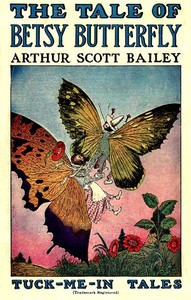
The catalog record for The Tale of Betsy Butterfly Tuck-Me-In Tales — Themes and Context provides practical reading context through 16,499 words, 1 hr 12 min estimated reading time, and 2 detected text sections.
The text analysis averages about 12.3 words per sentence, while the detected sections provide another way to judge how the source is divided.
Project Gutenberg metadata also associates the work with “Animals -- Juvenile fiction,” connecting these edition facts with the source record’s subject description.
Explore this collection
These alternatives are selected using recorded categories and estimated reading time.
About 73 minutes
Childrens Adventures
16,778 recorded words. 1 minutes difference from this book's estimate.
View Gutenberg source #10220About 71 minutes
Childrens Adventures
16,168 recorded words. 1 minutes difference from this book's estimate.
View Gutenberg source #21412About 74 minutes
Childrens Adventures
16,936 recorded words. 2 minutes difference from this book's estimate.
View Gutenberg source #21836Search stored excerpts and compare books → Choose by your preferences →
Choices use stored catalog measurements. Estimates vary with reading speed. A shared category is a catalog label, not a claim that two books have the same argument or literary quality.
Search reads excerpt text stored with this catalog and links to its associated Gutenberg record. The connection is stored in the site database; this tool does not recheck that every excerpt is word-for-word identical to that external record. Excerpt search does not cover every chapter and does not verify historical publication dates.
Catalog snapshot checked: 2026-09-26. Coverage: 91 public books, 91 available source excerpts.
Calculated from edition completeness, EPUB availability, text structure and catalogue metadata. Not a user rating.
Total of 100 points, scaled to a 2.5-5.0 range. Editions with an empty description or a missing EPUB file are not scored.
Public-domain source text
The source text is kept in the dedicated reader, separate from this catalogue record and its commentary.
Arthur Scott Bailey opens The Tale of Betsy Butterfly by establishing a community built on contrast: Jasper Jay is the noisiest, Peter Mink the rudest, Freddie Firefly the brightest after dark. Against this backdrop, Betsy Butterfly is introduced as "the loveliest"—not merely in appearance but in graceful flight, her red-and-brown mottled wings with violet tips. Bailey's narrator immediately undercuts the praise, noting that Betsy herself would have preferred the name Violet, and that jealous neighbors like Mehitable Moth whisper she "paints her wings." This early tension between admiration and envy sets the stage for a story driven less by plot than by social dynamics and the characters' own words.
Bailey's word choices reveal character through subtle gradations of tone. When Mehitable Moth remarks to Mrs. Ladybug that Betsy's color "isn't natural," the phrase "between you and me" signals conspiratorial gossip. Mrs. Ladybug's reply—"I don't doubt it"—is clipped, suggesting either agreement or polite dismissal. Later, Chirpy Cricket and Daddy Longlegs orchestrate a party to expose Joseph Bumble, with Chirpy predicting he "will come without being invited." The narrator's dry observation that Joseph "did not feel the least bit shy about coming" and his claim to "royal blood" are rendered in a voice that is neither approving nor condemning, letting the reader judge the speaker's pomposity. Bailey's diction consistently favors concrete, slightly formal nouns—"field people," "forest folk," "upstart Bumble's boasting"—that lend a mock-heroic gravity to insect squabbles.
Conversations in the excerpt function less as information exchange than as performances of status and alliance. Joseph Bumble's speech is a parade of self-importance: "Being of a royal family, I never wait to be asked to a place." The narrator undercuts him by noting that his words "proved partly true, anyhow"—the other characters rush to welcome him, but their motives are suspect. Daddy Longlegs' question—"Are you sure it wasn't yourself that you heard?"—is a pointed jab masked as innocence. Betsy Butterfly herself speaks little in the provided text; her role is to be admired and, later, to be the object of schemes. Bailey uses dialogue to show how characters jockey for position: Chirpy Cricket proposes the plan to invite Buster Bumblebee, while Daddy Longlegs volunteers for the errand, each playing a part in the social drama.
The narrative structure in these chapters relies on a gradual accumulation of doubt. Chapter XIV, "A Deep Plot," opens with Betsy's admirers growing "very peevish" at Joseph Bumble's influence. Chirpy Cricket's suggestion to invite Buster Bumblebee is presented as a logical test: "Let's ask Buster to come over to the meadow so that he may meet this cousin of his!" The plan is executed with careful attention to logistics—Daddy Longlegs' journey is described as "half a day's journey"—and the party itself becomes a stage for revelation. Bailey builds tension through small details: Joseph's interruption by a loud voice, his complaint, and Daddy Longlegs' pointed question about whether he heard himself. The reader is left waiting for the confrontation, which the excerpts do not resolve, but the structure ensures that every character's action contributes to the mounting social pressure.
Bailey uses setting to reinforce character traits. Betsy Butterfly "couldn't abide bad weather—not even a cloudy sky" and flies only in sunshine, a detail that aligns her beauty with fair weather and makes her absence during storms a natural consequence of her nature. The meadow and clover field are not mere backdrops but sites of social distinction: Joseph Bumble prefers the meadow with Betsy, while his supposed cousin Buster spends time in the clover patch. Daddy Longlegs' journey to invite Buster is made easier by the absence of wind, a small but telling detail that the narrator notes explicitly. The weather thus becomes a silent participant in the plot, enabling or hindering the characters' schemes without moralizing. Bailey's descriptions are economical—"the stone wall where he lived"—but each location carries social meaning.
Readers attentive to Bailey's craft will notice how much of the story's tension arises not from action but from what characters say about one another. The excerpts offer no resolution to Joseph Bumble's true identity, but they demonstrate how gossip, flattery, and suspicion drive the narrative. Pay particular attention to the narrator's deadpan asides—they often reveal more than the characters themselves intend.
I’ve often sat with The Tale of Betsy Butterfly, admiring how Bailey lets each insect’s chatter reveal their heart’s weather. That same gentle trust in quiet detail lives in The Blue Envelope — A Closer Reading, where a small object holds an entire world’s longing. Both feel like old friends whispering, not performing, their truths.
Build a private reading journal entry for this title.









