
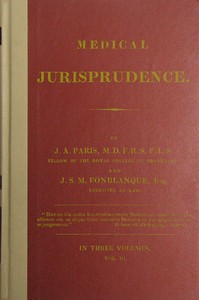
Medical Jurisprudence, Volume 3 (of 3) by John Ayrton Paris and J. S. M. Fonblanque
Let's be clear from the start: this isn't a novel. Medical Jurisprudence, Volume 3 is the final piece of a massive guidebook written in the 1820s. Its job was to teach doctors and lawyers how to speak the same language in court. The 'story' here is the real-life puzzle of solving crimes and settling legal disputes with the limited medical tools of the era.
The Story
The book tackles the grim but fascinating questions that plagued courtrooms. How do you prove someone died from arsenic poisoning when tests were primitive? Can you tell if a drowning victim was dead before they hit the water? The authors walk through these problems step-by-step, using case studies and medical principles. They cover topics like determining the cause of death in suspicious cases, identifying signs of insanity for legal defense, and untangling the medical facts in cases of assault or abortion. The central tension is always between medical possibility and legal proof.
Why You Should Read It
What makes this compelling is the raw humanity and high stakes on every page. You're reading the birth of modern forensics. When they debate how long a body has been dead based on rigor mortis, they're building the rules that would later become standard. You feel the weight on these early experts' shoulders. A wrong opinion could convict an innocent person or let a murderer go free. It's history, science, and law colliding in the most dramatic way possible. It strips away our modern certainty and shows just how difficult it was to find the truth.
Final Verdict
This is a niche read, but a brilliant one. It's perfect for history buffs who love social history, true crime enthusiasts curious about the roots of forensics, or anyone in the medical or legal fields who wants to see where it all began. It's not a light read—you have to meet it on its own terms—but the insights into how Victorians grappled with truth, justice, and the limits of science are absolutely worth it. Approach it like a fascinating historical document, and you'll be rewarded.
This masterpiece is free from copyright limitations. You do not need permission to reproduce this work.




William Thompson
6 months agoLoved it.