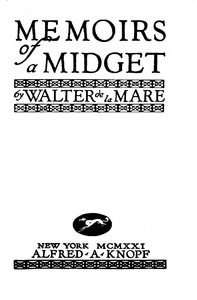
Memoirs of a Midget by Walter De la Mare
I picked up this book expecting a quirky period piece, but I found something much deeper. Published in 1921, it's written as the discovered diary of a woman known only as Miss M. It follows her life from childhood to adulthood, detailing her relationships with her family, her stern governess, and the various people who enter her orbit, from kind friends to those who want to exploit her uniqueness.
The Story
The plot isn't driven by wild events, but by the steady current of Miss M.'s life. After being orphaned, she goes to live with a wealthy, eccentric woman named Mrs. Bowater, becoming a companion of sorts. Here, she forms complex friendships with Mrs. Bowater's daughter Fanny and a skeptical clergyman, Mr. Anon. The central tension comes from the world's reaction to her. Some see a fragile doll to be protected, others a fascinating oddity to be displayed. Miss M. herself is witty, perceptive, and fiercely independent, constantly wrestling with how to be herself in a world that has already decided who she is.
Why You Should Read It
This book got under my skin. Walter de la Mare uses Miss M.'s physical perspective to offer a brilliant social and emotional one. From her literal lower vantage point, she notices the dirt on the floorboards, the hidden expressions on people's faces, and the hypocrisy of 'polite' society. It's a powerful metaphor for anyone who's ever felt out of place or misunderstood. Her voice is what makes it special—she's not a victim, but a sharp, sometimes sarcastic commentator on the strange world of 'normal-sized' people. It made me think about my own assumptions and how we treat difference.
Final Verdict
This is a book for readers who love character studies and beautiful, thoughtful prose. If you enjoy novels that explore the inner life of a fascinating narrator, like The Remains of the Day or Gilead, you'll find a friend in Miss M. It's not a fast-paced page-turner; it's a slow, immersive experience. Perfect for a quiet weekend, for anyone interested in perspectives from the edges of society, or for readers who believe the most profound stories are often found in the quietest lives.
No rights are reserved for this publication. Share knowledge freely with the world.