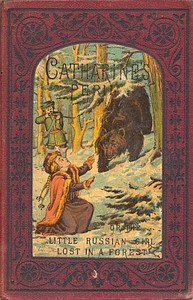
The collection opens with a panoramic view of Moscow in 1812—its winding streets, hills, churches, and the Kremlin—before narrowing to the plight of Catharine Somoff, a merchant's daughter separated from her family during the fire. This movement from sweeping historical description to a child's peril establishes a pattern of shifting scale that recurs across the three stories. The narrator's eye moves from the conflagration that 'lasted about ten days' to the specific terror of a lost girl, then later to the intimate encounters of a disguised earl and a domestic fire in a narrow alley. These transitions between public catastrophe and private trial give the volume its distinctive rhythm.
From Burning City to Forest: The Opening Movement
The title story begins with a detailed account of Napoleon's invasion and the burning of Moscow, attributed to Governor Rostopchin's 'bigoted patriotism.' The prose lingers on the 'heart-rending sight' of inhabitants fleeing and the ten-day conflagration that 'laid almost the whole of Moscow in ashes.' Only after this historical stage is set does the narrative zoom in on Catharine, who 'had been separated from her relations and friends' amid the confusion. The shift is abrupt: from the scale of an army of 400,000 to a single child lost in a forest. This structural choice—using history as a backdrop for personal ordeal—recurs in the later stories, though with less dramatic contrast. The Cossacks, described as 'first-rate riders, with lances ten feet long,' remain a vivid detail that anchors the setting.
Disguise and Recognition in 'The Shabby SurTOUT'
The second story, 'The Shabby SurTOUT,' abandons the war setting for a Scottish tour. The narrator encounters a young man in a 'surtout that was not over new,' who later proves to be the Earl of Hyndford traveling incognito. The story hinges on the gap between appearance and reality: the earl's shabby coat conceals his rank, and his method of testing a schoolmaster—by sitting through a class and asking about prayer—reveals his character. The narrator's recognition of the coat's 'claret colour' ties the tale together. This motif of hidden identity echoes the earlier story's theme of displacement: Catharine is lost in a forest, while the earl is lost in plain sight. Both narratives reward attention to small details—a coat, a prayer, a child's cry.
Fire as a Recurring Image
Fire appears in all three stories, though with different causes and consequences. In the title story, Moscow burns by design, consuming provisions and forcing evacuation. In 'Jane Hill,' a fire 'originated, as fires so often do, in the carelessness ... of a tipsy woman' who left a candle burning. The later fire is domestic, confined to a narrow alley, and the culprit is rescued through a window. The contrast between the grand, patriotic arson of Rostopchin and the squalid accident of a drunken woman underscores the collection's range. Both fires, however, displace people: Catharine loses her family, while Jane Hill's neighborhood loses homes. The repetition of fire as a turning point gives the volume a thematic unity, even as the settings shift from Russia to Scotland.
Narrative Framing and the First-Person Witness
The collection employs a first-person narrator who appears in the second and third stories but not the first. In 'The Shabby SurTOUT,' the narrator is a traveler who recounts his encounter with the earl; in 'Jane Hill,' he is a resident who describes a fire 'in the poorer parts of the town in which I live.' This framing device creates a sense of immediacy and reliability, as the narrator claims to have witnessed or heard the events firsthand. Yet the title story is told in an omniscient third person, with historical authority. The shift in voice—from detached historian to involved observer—mirrors the movement from public to private. The narrator's presence in the later tales also allows for moral commentary, such as the reflection that 'not many wise men after the flesh ... are called.'
Readers may find it useful to pay attention to the way each story opens: the first with a historical essay, the second with a chance meeting, the third with a moral epigraph. These different openings signal the collection's varied registers. The recurring images of fire, disguise, and displacement invite comparison across the three tales, even though they are set in different countries and decades. The volume rewards a slow reading that notes how small details—a coat, a candle, a child's cry—connect the grand and the intimate.
Sometimes I think about Moscow burning while a child is lost, and how sharper that grief cuts than any quiet scene of charity. Then I recall the damp, patient slog through black-water swamps in Boy Scouts on a Long Hike; Or, To the Rescue in the Black Water Swamps — Themes and Context—both books know that rescue wears a weary face, and that’s a small comfort on a gray afternoon.