About 184 minutes
His big opportunity — Themes and Context
Childrens Adventures
42,273 recorded words. 2 minutes difference from this book's estimate.
View Gutenberg source #11470
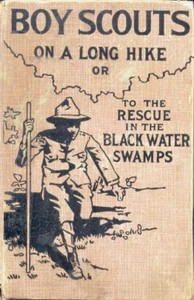
Before opening Boy Scouts on a Long Hike; Or, To the Rescue in the Black Water Swamps — Themes and Context, the edition data offers a quick orientation: 41,727 words, 3 hr 2 min estimated reading time, and 5 detected text sections.
The text analysis averages about 21.0 words per sentence, while the detected sections provide another way to judge how the source is divided.
Project Gutenberg metadata also associates the work with “Hiking -- Juvenile fiction,” connecting these edition facts with the source record’s subject description.
Explore this collection
These alternatives are selected using recorded categories and estimated reading time.
About 184 minutes
Childrens Adventures
42,273 recorded words. 2 minutes difference from this book's estimate.
View Gutenberg source #11470About 188 minutes
Childrens Adventures
43,115 recorded words. 6 minutes difference from this book's estimate.
View Gutenberg source #15281About 173 minutes
Childrens Adventures
39,609 recorded words. 9 minutes difference from this book's estimate.
View Gutenberg source #21383Search stored excerpts and compare books → Choose by your preferences →
Choices use stored catalog measurements. Estimates vary with reading speed. A shared category is a catalog label, not a claim that two books have the same argument or literary quality.
Search reads excerpt text stored with this catalog and links to its associated Gutenberg record. The connection is stored in the site database; this tool does not recheck that every excerpt is word-for-word identical to that external record. Excerpt search does not cover every chapter and does not verify historical publication dates.
Catalog snapshot checked: 2026-09-26. Coverage: 91 public books, 91 available source excerpts.
Calculated from edition completeness, EPUB availability, text structure and catalogue metadata. Not a user rating.
Total of 100 points, scaled to a 2.5-5.0 range. Editions with an empty description or a missing EPUB file are not scored.
Public-domain source text
The source text is kept in the dedicated reader, separate from this catalogue record and its commentary.
The Beaver Patrol of Beverly, Indiana, is introduced mid-boast: “It’s only a measly little twenty-five miles per day,” declares one scout, setting the tone for a story that treats physical challenge as a point of pride. The opening chapter quickly establishes the patrol’s members—Seth, Jotham, Eben, Andy, Fritz, and “Noodles” Krafft—each with a defined role, from bugler to signal sender. The narrative voice is brisk and colloquial, peppered with exclamations like “Gee! whiz!” and period slang such as “bally old thing.”
The catalog subjects—hiking, Boy Scouts, and swamps—are all present, but the excerpts reveal a stronger emphasis on rescue and emergency response than the subjects alone suggest. The balloonist’s crash in Chapter IX shifts the plot from a routine hike to a life-or-death mission, with the scouts mobilizing to aid a stranded aeronaut named Anderson.
The excerpts showcase a range of scout skills woven into the narrative. In the opening scene, the boys carry signal flags, pieces of a broken looking-glass (for heliograph signaling), and a smoke-stained blanket used for smoke-code communication. These details are not merely decorative; they are integral to the plot, as the patrol’s training directly enables their response to the balloonist’s distress. The text emphasizes that the scouts are “through the mill” and wear “merit badges all around,” suggesting a hierarchy of competence. The bugler Eben, initially mocked for his poor playing, has “mastered his silver-plated bugle,” showing a subplot of skill development. The author uses these elements to demonstrate the practical application of scoutcraft, rather than simply listing it.
The balloon rescue sequence in Chapters IX and X is the most detailed event in the excerpts. The balloon Great Republic drifts overhead, partially collapsed, with the aeronaut clinging to broken ropes. The scouts watch as it heads toward the Black Water Swamps, a place where “up to now never a human being has set foot.” The man shouts down: “Accident—badly wrenched leg—follow up, and bring help—Anderson, from St. Louis.” The author builds tension through the boys’ reactions—Eben’s “There she goes down, fellers!” and Fritz’s “Gee! whiz! that’s tough!”—and through precise details like the balloon’s altitude (“sixty or seventy feet”) and the failed attempt to grab a trailing rope. The scene grounds the adventure in a specific, dangerous setting.
The language of the excerpts places the book firmly in its 1913 origin. Characters use expressions like “bally old thing,” “flat-footed,” and “rampaged through this region,” and refer to Native American tribes (Shawnees, Sacs, Pottawattomies) in a manner typical of the era. The setting is explicitly Indiana, with Beverly as a “bustling” town and the swamp described as a trackless wilderness. The author, Archibald Lee Fletcher, writes in a direct, action-oriented style, with short paragraphs and frequent dialogue. The narrative assumes a reader familiar with scout culture—terms like “tenderfoot class” and “merit badges” are used without explanation. These elements combine to create a distinct historical atmosphere that modern readers may find instructive about early 20th-century children’s adventure fiction.
The excerpts offer a clear window into the book’s structure: a brisk setup, a dramatic incident, and a rescue mission. Readers interested in early Boy Scout fiction or period adventure stories will find this a representative example. The text rewards attention to the specific scout skills depicted, which are not just window dressing but drive the plot. For a fuller understanding, note how the catalog subjects—hiking, swamps, scouting—are all subordinated to the rescue narrative, a pattern common in series books of the time.
That rainy afternoon, the boys’ determined slog through the Black Water Swamps felt almost cozy against the window’s drumming. Their rescue of the fallen balloonist reminded me how a quiet impulse can shift an entire day. Later, I stumbled onto a stranger’s tale of a monkey and an admiral’s dinner. Tom Finch's Monkey and How he Dined with the Admiral — A Closer Reading, it’s called. One unexpected turn, leading to another, the way such afternoons often go.
Answer a few questions and save a private reflection on this device.









