About 209 minutes
Bunny Brown and His Sister Sue on an Auto Tour — Reading Notes
Childrens Adventures
48,021 recorded words. 1 minutes difference from this book's estimate.
View Gutenberg source #17095
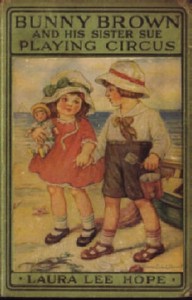
Bunny Brown and His Sister Sue Playing Circus — Story, Setting & Ideas can be approached with a clearer sense of reading commitment from its source measurements: 48,297 words, 3 hr 30 min estimated reading time, and 6 detected text sections.
The text analysis averages about 11.8 words per sentence, while the detected sections provide another way to judge how the source is divided.
Project Gutenberg metadata also associates the work with “Siblings -- Juvenile fiction,” connecting these edition facts with the source record’s subject description.
Explore this collection
These alternatives are selected using recorded categories and estimated reading time.
About 209 minutes
Childrens Adventures
48,021 recorded words. 1 minutes difference from this book's estimate.
View Gutenberg source #17095About 211 minutes
Childrens Adventures
48,306 recorded words. 1 minutes difference from this book's estimate.
View Gutenberg source #19120About 212 minutes
Childrens Adventures
48,693 recorded words. 2 minutes difference from this book's estimate.
View Gutenberg source #22365Search stored excerpts and compare books → Choose by your preferences →
Choices use stored catalog measurements. Estimates vary with reading speed. A shared category is a catalog label, not a claim that two books have the same argument or literary quality.
Search reads excerpt text stored with this catalog and links to its associated Gutenberg record. The connection is stored in the site database; this tool does not recheck that every excerpt is word-for-word identical to that external record. Excerpt search does not cover every chapter and does not verify historical publication dates.
Catalog snapshot checked: 2026-09-26. Coverage: 91 public books, 91 available source excerpts.
Calculated from edition completeness, EPUB availability, text structure and catalogue metadata. Not a user rating.
Total of 100 points, scaled to a 2.5-5.0 range. Editions with an empty description or a missing EPUB file are not scored.
Public-domain source text
The source text is kept in the dedicated reader, separate from this catalogue record and its commentary.
Laura Lee Hope opens Bunny Brown and His Sister Sue Playing Circus with a child’s question—"Grandpa, where are you going now?"—and immediately establishes a pattern of paired dialogue: Bunny asks, then Sue echoes with a variation. This double-question structure recurs throughout the excerpts, creating a rhythm that mimics the way young siblings negotiate attention and information. Hope rarely lets a single child speak alone; instead, she weaves their voices together, often with one correcting or extending the other’s thought. The result is a conversational texture that feels both natural and deliberately crafted to show the children as a unit.
Hope’s word choices consistently filter the world through a child’s understanding. Objects are described by their immediate function or appearance: a basket is “too big for eggs,” a sail is a “bag,” and a broken mast is simply a “beanpole.” The narrator adopts the children’s own vocabulary, as when Sue speculates about “great, great, big eggs” or when Bunny calls the hen “trained.” This lexical simplicity does not feel condescending; rather, it aligns the reader’s viewpoint with the protagonists’. Even the hen’s clucking is translated into direct speech—“Cluck! Cluck! Cluck!”—and then glossed as “hen talk,” a move that treats animal sounds as a language the children can interpret. Such choices reinforce a world where logic is playful and boundaries between human and animal communication are porous.
The dialogue between Bunny and Sue reveals distinct personalities through subtle verbal habits. Bunny tends to make declarative observations and offer explanations: “That basket is too big for eggs,” he says, and later he comforts Sue with “Never mind.” Sue, by contrast, often asks clarifying questions or repeats information in narrative form, as when she recaps the accident to her mother: “we gave the old hen a ride … and the wind broke our sail, and it fell on me, and the ducks flew away … and Bunny fell in.” Her speech strings events together with repeated “ands,” mimicking the way a young child retells a story without subordination. Hope uses these differences to create a dynamic where Bunny is the problem-solver and Sue the commentator, yet neither voice dominates; they trade lines like a practiced duo.
When the raft’s mast breaks, Hope shifts into short, punchy sentences that mirror the suddenness of the accident: “All at once there was a cracking sound, and the raft turned to one side. … Something flew down over her head, covering her eyes, and she could see nothing.” The description is stripped of metaphor or elaboration; the reader experiences the event through Sue’s sensory confusion—a sound, a turn, a covering. Bunny’s fall is reported in the same clipped style: “I slipped in when the wind broke the sail. I—I fell on my back, and a lot of water got in my nose and mouth, but—but I got on my feet.” The dashes and repetitions convey his breathlessness without the narrator needing to state it. Hope trusts the rhythm of the prose to carry the emotion, avoiding any authorial commentary on danger or fear.
Two motifs recur across the excerpts: the idea of a “trained” animal and the children’s impulse to turn mishaps into future plans. After the hen follows her ducklings, Bunny declares, “She is just like a trained hen. If we have another and bigger circus, Sue, we can have this hen in it.” This moment links the accidental raft ride to the circus plot, showing how the children reinterpret everyday events as material for their play. Similarly, when Bunny falls in the pond, the incident is immediately folded into the ongoing adventure rather than treated as a crisis. Hope structures the narrative around these small transformations: a broken sail becomes a story, a hen’s behavior becomes a circus act. The pattern suggests that for Bunny and Sue, the world is a source of raw material for their imaginative projects, and the author’s job is to record their resourcefulness.
Readers attentive to authorial craft will notice how Laura Lee Hope balances repetition with variation: the children’s paired questions, the animal sounds, the near-accidents that resolve without adult intervention. The excerpts offer a compact lesson in writing for a young audience—using concrete diction, rhythmic dialogue, and a narrative voice that stays close to its characters’ perceptions. The full book likely extends these techniques across longer sequences of play and problem-solving, rewarding a close reading of how Hope builds a world from the ground up, one child’s question at a time.
Reading about Bunny Brown’s unhurried, sunlit circus preparations, I remembered how the woods in The Tale of Betsy Butterfly Tuck-Me-In Tales — Themes and Context carry that same soft, patient hush—where a child’s imagination lingers on small wings and whispered sounds, not grand gestures, just quiet wonder held gently in the afternoon air.
Save your reaction, strongest insight, and memorable passage.









