About 210 minutes
Bunny Brown and His Sister Sue Playing Circus — Story, Setting & Ideas
Childrens Adventures
48,297 recorded words. 1 minutes difference from this book's estimate.
View Gutenberg source #16956
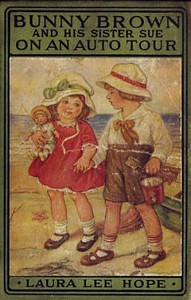
The source record for Bunny Brown and His Sister Sue on an Auto Tour — Reading Notes measures this digital text at 48,021 words, 3 hr 29 min estimated reading time, and 6 detected text sections.
The text analysis averages about 12.6 words per sentence, while the detected sections provide another way to judge how the source is divided.
Project Gutenberg metadata also associates the work with “Siblings -- Juvenile fiction,” connecting these edition facts with the source record’s subject description.
Explore this collection
These alternatives are selected using recorded categories and estimated reading time.
About 210 minutes
Childrens Adventures
48,297 recorded words. 1 minutes difference from this book's estimate.
View Gutenberg source #16956About 211 minutes
Childrens Adventures
48,306 recorded words. 2 minutes difference from this book's estimate.
View Gutenberg source #19120About 212 minutes
Childrens Adventures
48,693 recorded words. 3 minutes difference from this book's estimate.
View Gutenberg source #22365Search stored excerpts and compare books → Choose by your preferences →
Choices use stored catalog measurements. Estimates vary with reading speed. A shared category is a catalog label, not a claim that two books have the same argument or literary quality.
Search reads excerpt text stored with this catalog and links to its associated Gutenberg record. The connection is stored in the site database; this tool does not recheck that every excerpt is word-for-word identical to that external record. Excerpt search does not cover every chapter and does not verify historical publication dates.
Catalog snapshot checked: 2026-09-26. Coverage: 91 public books, 91 available source excerpts.
Calculated from edition completeness, EPUB availability, text structure and catalogue metadata. Not a user rating.
Total of 100 points, scaled to a 2.5-5.0 range. Editions with an empty description or a missing EPUB file are not scored.
Public-domain source text
The source text is kept in the dedicated reader, separate from this catalogue record and its commentary.
The story opens with Bunny and Sue rushing home from school to report that something has happened next door. Their mother assumes a fire or injury, but the children clarify that they heard Mrs. Ward crying, and Bunny suspects it is about their boy Fred. This immediate introduction of a missing-child mystery sets a clear narrative hook: the family's auto tour will be intertwined with the search for Fred. The dialogue is brisk, with Bunny and Sue speaking in overlapping, breathless sentences that convey urgency and sibling teamwork. Mrs. Brown's practical response—laying down her sewing to go help—establishes a pattern of adult responsiveness that recurs throughout the excerpts.
The opening chapter quickly establishes Fred Ward as a problem to be solved. Bunny overhears crying next door and deduces, “I guess it must be about their boy Fred.” This single line, early in the text, primes readers to expect that the auto tour will involve searching for Fred. Later excerpts confirm this: Bunny states, “We've got to find that missing Fred Ward,” and Mr. Brown responds that they may find trace of him in Portland, but not for weeks. The mystery is not resolved within the provided excerpts, so readers must continue to see if the search succeeds. The author uses Fred’s absence to give the journey purpose beyond sightseeing, turning each stop into a potential clue.
Midway through the excerpts, the Browns’ automobile is described as a large vehicle “in which a family could live as they traveled.” Local children react with “Ohs!” and “Ahs!”, and one girl calls it “just like Mother Goose or a fairy story.” Bunny invites them inside to “show ’em our bunks,” emphasizing the domestic, almost magical quality of the car. This detail—the car as a home on wheels—shapes the reading experience by making the journey feel cozy and adventurous simultaneously. The vehicle is not merely transportation; it is a setting for family life, meals, and play. The nickname “Ark” reinforces the idea of a safe vessel carrying the family through unknown territory.
A recurring pattern in the excerpts is the chase of an animal that turns out to be something other than expected. In one scene, Dix chases a gray creature up a tree. Sue assumes it is a cat, but Bunny insists, “Maybe it wasn't a kittie,” and wants to see first. The narrative then notes that dogs often bark without knowing why, a wry observation that undercuts the drama. This moment echoes earlier incidents: the near-collision with a hay wagon (which Bunny compares to a feather bed) and the chase of a cow in the table of contents. These episodes train readers to expect comic misadventures rather than real danger, and to question initial appearances—a useful lens for interpreting later events.
The excerpts show a deliberate alternation between action and quiet travel. After the hay-wagon incident, the narrative shifts to “two more days” of uneventful driving, then jumps to a supper-time scene where Dix chases the gray animal. This rhythm—crisis, then calm, then new crisis—keeps the story moving without exhausting the reader. The table of contents lists twenty-five chapters with titles like “In the Flood,” “At the Fire,” and “A Lion Is Loose,” suggesting that the provided excerpts represent only the early stages of a longer, eventful tour. Readers who enjoy the mix of mystery, family dynamics, and gentle humor in these opening chapters can expect more of the same throughout the book.
The excerpts establish a clear pattern: a missing-boy mystery, a mobile home that feels like a fairy tale, and animal chases that teach skepticism of first impressions. First-time readers should pay attention to how the search for Fred evolves, and whether the “Ark” remains a safe haven as the journey progresses. The book rewards those who enjoy episodic adventures with a light touch of suspense.
That feeling of wandering—how the Ark carried its family through one small mishap after another—stayed with me long after finishing. There’s something tender about gentle confusion, the way wrong turns still bring you somewhere. I found that same quiet loneliness, oddly comforting, in Yr Ynys Unyg; or, The lonely island — Story, Setting & Ideas. Its stillness felt like a soft pause, not an absence. Both lingered like a warm, half-remembered afternoon.
Your answers remain private and are stored only in this browser.









