About 83 minutes
Doctor Rabbit and Brushtail the Fox — Story, Setting & Ideas
Childrens Adventures
18,922 recorded words. 4 minutes difference from this book's estimate.
View Gutenberg source #18667
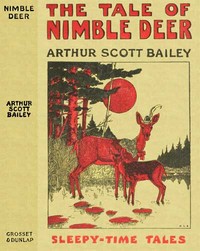
The catalog record for The Tale of Nimble Deer Sleepy-Time Tales — Text and Context provides practical reading context through 18,064 words, 1 hr 19 min estimated reading time, and 3 detected text sections.
The text analysis averages about 11.8 words per sentence, while the detected sections provide another way to judge how the source is divided.
Project Gutenberg metadata also associates the work with “Animals -- Juvenile fiction,” connecting these edition facts with the source record’s subject description.
Explore this collection
These alternatives are selected using recorded categories and estimated reading time.
About 83 minutes
Childrens Adventures
18,922 recorded words. 4 minutes difference from this book's estimate.
View Gutenberg source #18667About 75 minutes
Childrens Adventures
17,164 recorded words. 4 minutes difference from this book's estimate.
View Gutenberg source #21844About 74 minutes
Childrens Adventures
16,936 recorded words. 5 minutes difference from this book's estimate.
View Gutenberg source #21836Search stored excerpts and compare books → Choose by your preferences →
Choices use stored catalog measurements. Estimates vary with reading speed. A shared category is a catalog label, not a claim that two books have the same argument or literary quality.
Search reads excerpt text stored with this catalog and links to its associated Gutenberg record. The connection is stored in the site database; this tool does not recheck that every excerpt is word-for-word identical to that external record. Excerpt search does not cover every chapter and does not verify historical publication dates.
Catalog snapshot checked: 2026-09-26. Coverage: 91 public books, 91 available source excerpts.
Calculated from edition completeness, EPUB availability, text structure and catalogue metadata. Not a user rating.
Total of 100 points, scaled to a 2.5-5.0 range. Editions with an empty description or a missing EPUB file are not scored.
Public-domain source text
The source text is kept in the dedicated reader, separate from this catalogue record and its commentary.
Arthur Scott Bailey opens The Tale of Nimble Deer with a striking simile: Nimble's mother declares her newborn fawn is "not much taller than an overgrown beet top" and his legs are "no thicker than pea pods." This homely comparison, drawn from garden vegetables rather than forest imagery, immediately establishes the story's domestic, farm-adjacent setting. Bailey consistently anchors the animal characters' concerns in tangible, everyday objects—cabbages, carrot patches, hat-racks—rather than abstract concepts. The dialogue, too, reveals character through idiom: Nimble's mother speaks in exclamatory, maternal fussing, while old Mr. Crow uses sly, provocative phrases like "Ladies are too finicky."
Bailey repeatedly measures Nimble against garden produce. The newborn fawn is compared to a beet top and a cabbage; later, the narrative mentions Farmer Green's early June peas. These choices root the story in a human-managed landscape, not a wild forest. The mother deer's fondness for "certain vegetables that did not grow wild" further blurs the line between wild animal and domestic creature. By using edible plants as yardsticks, Bailey makes Nimble's size and vulnerability concrete for young readers. The metaphors also hint at the deer's eventual raids on Farmer Green's garden, a plot point that emerges naturally from this early imagery.
Each character speaks with a distinct verbal tic. Nimble's mother uses exclamations and rhetorical questions: "Bless me!" and "They'll be ready to eat in another month." Old Mr. Crow, by contrast, employs short, cynical commands: "Go it!" and "I'd have my fun if I wanted to." The narrator describes him as a "famous trouble maker," and his dialogue confirms this—he eggs on the mock battles with squalled encouragement. Nimble himself shifts from naive exclamations ("See what I've got! Antlers! Two points!") to more measured speech as he matures. Bailey uses these vocal patterns to advance character without lengthy description.
The mock battles between Nimble and Dodger recur across multiple chapters, each time with slight variations. Bailey describes the physical action with precise verbs: "clashed his horns," "tore into each other," "leaped aside." The sound of antlers sends "a thrill through Nimble" and makes his coat bristle. These scenes serve as both action and social commentary—the deer's play fighting is observed by Mr. Crow, who treats it as entertainment, and by Nimble's mother, who warns of injury. Bailey uses the repeated ritual to mark Nimble's growth: as his antlers gain points, the battles become more serious. The structure mirrors the deer's development from fawn to three-pointer.
Bailey's narrator adopts a confiding, slightly amused tone. Parenthetical asides like "meaning not her child's legs, as you might have supposed" directly address the reader. The story is part of the "Sleepy-Time Tales" series, and the prose reflects that: sentences are short, events are episodic, and each chapter ends with a natural pause. The narrator occasionally undercuts the animals' self-importance—Nimble's pride in his two-point antlers is deflated when Dodger reveals that "two-pointers are common this season." This gentle irony keeps the tone light while still conveying the social dynamics of the deer herd.
Readers attentive to Bailey's word choices will notice how he builds a coherent world from small, consistent details: the garden metaphors, the distinct voices, the repeated ritual of mock battle. The story rewards attention to its craft even as it offers a straightforward animal adventure. For those interested in early twentieth-century children's literature, this tale exemplifies how series writers like Bailey developed recognizable narrative fingerprints across multiple titles.
Bailey’s careful woodland diction, that unhurried precision in Nimble Deer’s voice, always reminds me of another quiet favorite. There is a similar patience in watching a creature misunderstand its own nature, a tenderness for folly. The Faithless Parrot — Story, Setting & Ideas holds that same gentle ache, a feather-light lesson that lingers long after the shelf light dims.
Build a private reading journal entry for this title.