About 242 minutes
The Girl Scouts' Good Turn — Background and Themes
Childrens Adventures
55,594 recorded words. 1 minutes difference from this book's estimate.
View Gutenberg source #24248
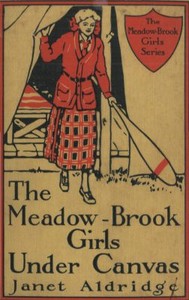
The catalog record for The Meadow-Brook Girls Under Canvas; Or, Fun and Frolic in the Summer Camp — A Reader’s Guide provides practical reading context through 55,761 words, 4 hr 3 min estimated reading time, and 6 detected text sections.
The text analysis averages about 12.5 words per sentence, while the detected sections provide another way to judge how the source is divided.
Project Gutenberg metadata also associates the work with “Friendship -- Juvenile fiction,” connecting these edition facts with the source record’s subject description.
Explore this collection
These alternatives are selected using recorded categories and estimated reading time.
About 242 minutes
Childrens Adventures
55,594 recorded words. 1 minutes difference from this book's estimate.
View Gutenberg source #24248About 249 minutes
Childrens Adventures
57,046 recorded words. 6 minutes difference from this book's estimate.
View Gutenberg source #13450About 235 minutes
Childrens Adventures
53,856 recorded words. 8 minutes difference from this book's estimate.
View Gutenberg source #19743Search stored excerpts and compare books → Choose by your preferences →
Choices use stored catalog measurements. Estimates vary with reading speed. A shared category is a catalog label, not a claim that two books have the same argument or literary quality.
Search reads excerpt text stored with this catalog and links to its associated Gutenberg record. The connection is stored in the site database; this tool does not recheck that every excerpt is word-for-word identical to that external record. Excerpt search does not cover every chapter and does not verify historical publication dates.
Catalog snapshot checked: 2026-09-26. Coverage: 91 public books, 91 available source excerpts.
Calculated from edition completeness, EPUB availability, text structure and catalogue metadata. Not a user rating.
Total of 100 points, scaled to a 2.5-5.0 range. Editions with an empty description or a missing EPUB file are not scored.
Public-domain source text
The source text is kept in the dedicated reader, separate from this catalogue record and its commentary.
From the opening chapter, Janet Aldridge establishes character through distinctive speech patterns. Grace Thompson, called "Tommy," consistently lisped dialogue such as "Conthulting the Oracle" and "I go, I thtay!"—a phonetic marker that sets her apart. Meanwhile, Margery Brown earns the nickname "Buster" through her dismissive retorts, like declaring she does not want to learn cooking. These verbal tics are not merely decorative; they immediately signal each girl's role within the Meadow-Brook group before any action occurs.
Nicknames in this novel function as shorthand for personality. Margery is "Buster" because of her blunt, rebellious attitude toward domesticity. Hazel Holland addresses her solemnly, noting her flushed face, and Margery retorts, "I'm not a sight." The name "Crazy Jane" for Jane McCarthy is earned through her impulsive actions—she crashes a car into a tent and declares the camp "stupid." Aldridge uses these labels to create immediate expectations, and the characters rarely deviate from the traits their nicknames imply.
Dialogue reveals social hierarchy and conflict. When Jane arrives, Patricia Scott responds sarcastically to Jane's tent-wrecking: "The tent is wrecked. That's all. However, don't let a little thing like that trouble you." Jane coolly turns her back, ignoring the jab. Cora Kidder whispers to Patricia, "Some strange people come out of Meadow-Brook, don't they, girls?" Aldridge uses these exchanges to show factions forming, with Harriet and Miss Elting siding with Jane. The author does not rely on narration to explain tensions; the characters' own words carry the drama.
Aldridge often pairs physical description with action to reinforce character. Jane "fairly flung herself into the arms of Harriet Burrell" and "darted off with long strides," dragging Tommy along. Her movements are forceful and unrefined. In contrast, Hazel Holland is described as "regarding Margery solemnly," a quieter, more observant posture. The author uses verbs like "tossed," "shook," and "grabbed" to differentiate energy levels. Even setting details, such as Jane's car "see-sawing to avoid obstructions," mirror her chaotic personality.
Certain phrases recur to cement character identity. Tommy's lisp appears in nearly every line she speaks, as in "Yeth," "tho glad," and "cry her eyeth out." Jane repeatedly uses "great" and "start something," as when she says, "Oh, we're going to have a great time" and "Let's get that car unloaded and start something." These verbal habits become predictable, but they also create a rhythmic consistency that helps readers track who is speaking even without dialogue tags.
Readers attentive to Aldridge's diction will notice how she builds a summer camp story almost entirely through talk and gesture. The excerpts do not reveal the full plot, but the author's method is clear: each girl's voice is a tool for both comedy and conflict. Pay attention to who speaks politely, who interrupts, and who uses nicknames—these choices carry the story's social dynamics.
That rainy afternoon, the Meadow-Brook girls' lisping chatter and nicknames felt like sound itself, each voice a distinct weather pattern. I closed the guide, and my hand drifted to an older spine on the shelf. The quiet, wandering rhythm of Uncle Wiggily's Travels — Reading Notes seemed to answer that same gentle question: how a voice carries a whole world along with it.
Capture what you thought, learned, and would like to remember.









