About 114 minutes
The Boy Scouts of the Geological Survey — A Closer Reading
Childrens Adventures
26,064 recorded words. 3 minutes difference from this book's estimate.
View Gutenberg source #12945
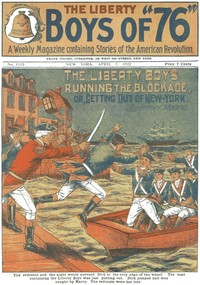
The catalog record for The Liberty Boys Running the Blockade; or, Getting Out of New York — Inside the Classic provides practical reading context through 25,448 words, 1 hr 51 min estimated reading time, and 3 detected text sections.
The text analysis averages about 16.7 words per sentence, while the detected sections provide another way to judge how the source is divided.
Project Gutenberg metadata also associates the work with “Historical fiction,” connecting these edition facts with the source record’s subject description.
Explore this collection
These alternatives are selected using recorded categories and estimated reading time.
About 114 minutes
Childrens Adventures
26,064 recorded words. 3 minutes difference from this book's estimate.
View Gutenberg source #12945About 114 minutes
Childrens Adventures
26,079 recorded words. 3 minutes difference from this book's estimate.
View Gutenberg source #21599About 117 minutes
Childrens Adventures
26,854 recorded words. 6 minutes difference from this book's estimate.
View Gutenberg source #11069Search stored excerpts and compare books → Choose by your preferences →
Choices use stored catalog measurements. Estimates vary with reading speed. A shared category is a catalog label, not a claim that two books have the same argument or literary quality.
Search reads excerpt text stored with this catalog and links to its associated Gutenberg record. The connection is stored in the site database; this tool does not recheck that every excerpt is word-for-word identical to that external record. Excerpt search does not cover every chapter and does not verify historical publication dates.
Catalog snapshot checked: 2026-09-26. Coverage: 91 public books, 91 available source excerpts.
Calculated from edition completeness, EPUB availability, text structure and catalogue metadata. Not a user rating.
Total of 100 points, scaled to a 2.5-5.0 range. Editions with an empty description or a missing EPUB file are not scored.
Public-domain source text
The source text is kept in the dedicated reader, separate from this catalogue record and its commentary.
The opening chapter, 'A Clever Capture,' establishes a pattern of surveillance and counter-surveillance that drives the narrative. Dick Slater spots a man in a 'steeple-crowned hat' following him and Bob Estabrook along Wall Street. Rather than confront him directly, Dick leads the man to Fraunces Tavern and deliberately delivers boastful talk about 'Polly Perkins' to disgust the listener and shake him off. The scene is less about military strategy than about testing a suspect's patience and nerve.
The second excerpt, from later in the book, shows a similar capture at a roadside inn. Dick and Bob corner the spy Hughson, who denies his identity and claims to be 'as good a rebel as yourself.' Bob immediately corrects him: 'We do not call ourselves rebels.' This insistence on terminology—rejecting the British label—is a small but consistent marker of the Liberty Boys' self-conception as legitimate soldiers, not insurgents.
The excerpts emphasize observation and misdirection over combat. Dick is described as 'very observant' and 'an expert spy himself,' and his methods involve reading body language and clothing. The steeple-crowned hat and the drover disguise are noted as easily read signals. When Hughson claims to be a drover, Bob is suspicious because the man called himself a rebel—a term the Liberty Boys reject. The capture at the inn relies on a prearranged signal: Bob imitates a crowing cock to summon Dick. These details suggest the book treats espionage as a contest of cleverness, not just a plot device.
The catalog subject 'New York (N.Y.) -- History -- Revolution, 1775-1783' is borne out by specific landmarks: Wall Street, Broad Street, Fraunces Tavern, the Commons, Greenwich village. The excerpts mention British ships at Staten Island and the threat of invasion. Yet the setting is not described in sweeping terms; it is a backdrop for tactical movement. The tavern serves as a neutral ground where officers and spies mingle. The inn outside the city is a place where Tories are absent and the landlord helps the patriots. These locations are functional, chosen for their strategic value in pursuit and escape.
The protagonists are introduced as 'well built and handsome, bronzed from exposure to the weather and wearing the uniform of the Continental army.' They are officers of the Liberty Boys, 'a band of one hundred sterling young patriots.' The term 'Liberty Boys' echoes the historical Sons of Liberty but is used here as a military unit name. The dialogue reinforces their identity: when Hughson calls them rebels, both Dick and Bob correct him. Bob says, 'We do not call ourselves rebels.' This verbal distinction—rejecting the British term—is a small but consistent marker of the Liberty Boys' self-conception as legitimate soldiers, not insurgents.
The excerpts show a book more interested in the mechanics of pursuit and capture than in battle scenes or political debate. Readers who enjoy following a trail of clues, disguises, and quick takedowns will find the Liberty Boys' methods engaging. The incomplete text leaves open how the blockade-running of the title unfolds, but the pattern of observation and counter-observation established in these chapters likely continues. Pay attention to how characters read each other's clothing, movements, and words—the story's tension depends on these small signals.
There’s a certain quiet ache in watching old friends navigate unfamiliar streets, whether it’s Dick and Bob slipping through British-held New York or the Motor Maids stepping ashore in Japan. That sense of being strangers in a place that feels almost like home stuck with me long after. The Motor Maids in Fair Japan — Background and Themes carries a similar tenderness, I think—like remembering a journey that changed how I see my own doorstep.
Save your reaction, strongest insight, and memorable passage.









