
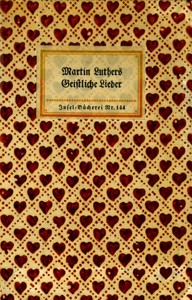
Martin Luthers Geistliche Lieder by Martin Luther
Let's set the scene. It's the early 1500s in Germany. The Catholic Church is the law, the culture, and the gatekeeper to heaven. Then a monk named Martin Luther nails 95 complaints to a church door, and everything starts to crack. But how do you explain these huge, complicated ideas about faith and freedom to farmers, blacksmiths, and housewives who can't read Latin? Luther's answer was music.
The Story
This book isn't a story with a plot in the usual sense. Think of it as a diary written in song. Luther took popular tunes from taverns and streets and rewrote the words. He turned them into powerful hymns like "A Mighty Fortress Is Our God," which wasn't just a nice melody—it was a defiant anthem for people being persecuted. Other hymns, like "From Heaven Above to Earth I Come," made the Christmas story feel personal and close. Each song tackles a different part of the human experience: fear, doubt, joy, and the search for a God who feels reachable. The "conflict" is in every line—it's the struggle of one man, and a whole movement, to find a voice.
Why You Should Read It
I'll be honest, I picked this up thinking it would be a dusty historical artifact. I was wrong. Reading these hymns, you get Luther unfiltered. You feel his terror, his stubbornness, and his deep desire for ordinary people to understand they mattered. The language is direct and strong. This isn't a distant God in a cathedral; this is a God who is a "fortress" and a "shield" in the middle of life's battles. It completely changed how I saw the Reformation. It wasn't just a political argument; it was a cultural takeover through song, and it worked because it spoke to people's hearts.
Final Verdict
Perfect for history lovers who want to go beyond dates and treaties, or anyone interested in how music and words can change the world. It's also great for people of faith (or those curious about it) who are tired of religious language that feels empty. This is the opposite—it's faith with its sleeves rolled up, gritty and real. You don't need to be a musician or a theologian to get it. You just need to appreciate powerful words that were meant to be shouted, not whispered.
This content is free to share and distribute. Feel free to use it for personal or commercial purposes.
Jennifer Jones
3 months agoFrom the very first page, the narrative structure is incredibly compelling. Truly inspiring.
Amanda Ramirez
1 year agoI came across this while browsing and the narrative structure is incredibly compelling. Thanks for sharing this review.
Michelle Anderson
7 months agoSolid story.
Sarah Jones
1 year agoSolid story.



Mark Garcia
1 year agoUsed this for my thesis, incredibly useful.