
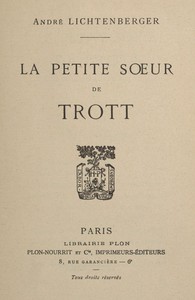
La petite sœur de Trott by André Lichtenberger
André Lichtenberger's La petite sœur de Trott is one of those quiet, forgotten books that deserves a second look. Published in 1898, it captures a very specific slice of French life while asking questions about nature, nurture, and belonging that still feel relevant.
The Story
The story centers on Trott, a young boy from a respectable Parisian family. Their orderly life is thrown into delightful chaos when a ragged, uncivilized little girl is discovered. She's taken in and named 'Moune,' but she's nothing like the children they know. She climbs furniture like trees, has bizarre manners, and communicates in a language of her own. The family, especially Trott's kind but baffled mother, tries to mold Moune into a proper little girl. The plot follows their often-humorous attempts at this 'taming,' and the unexpected bond that forms between the wild Moune and the gentle Trott. It's less about a huge dramatic event and more about the small, daily collisions between two completely different worlds under one roof.
Why You Should Read It
What I loved most was how Lichtenberger avoids easy judgments. He doesn't simply say 'wild is good' and 'civilized is bad.' Instead, he shows the friction and the beauty in both. Moune's raw, honest perspective makes you question all the unspoken rules we follow. The family's efforts, while sometimes misguided, usually come from a place of genuine care. Trott himself is a wonderful character—a boy caught between his affection for his strange new sister and the expectations of his world. The book is a gentle, insightful character study that makes you think about what we lose and gain when we're 'socialized.'
Final Verdict
This isn't a fast-paced adventure. It's a thoughtful, character-driven slice of life. It's perfect for readers who enjoy classic children's literature (think a French cousin to The Secret Garden), anyone interested in historical fiction about family and society, or people who just like discovering obscure, heartfelt stories from the past. Be prepared for a book that feels both of its time and strangely timeless in its central question: Can true belonging ever be taught, or does it have to grow wild first?
Legal analysis indicates this work is in the public domain. You do not need permission to reproduce this work.
Karen Brown
1 year agoAfter finishing this book, the narrative structure is incredibly compelling. A valuable addition to my collection.
Ethan Nguyen
2 months agoThanks for the recommendation.
Michelle Hill
7 months agoHaving read this twice, the plot twists are genuinely surprising. A valuable addition to my collection.
Emily Harris
10 months agoSimply put, the emotional weight of the story is balanced perfectly. Worth every second.






George Martin
3 months agoThe balance between academic rigor and readability is perfect.