About 252 minutes
The Rover Boys at College; Or, The Right Road and the Wrong — Background and Themes
Childrens Adventures
57,901 recorded words. 5 minutes difference from this book's estimate.
View Gutenberg source #10323
This digital edition of Grandmother Dear: A Book for Boys and Girls — Themes and Context is described by source-level measurements including 59,105 words, 4 hr 17 min estimated reading time, and 7 detected text sections.
The text analysis averages about 16.8 words per sentence, while the detected sections provide another way to judge how the source is divided.
Project Gutenberg metadata also associates the work with “Grandmothers -- Juvenile fiction,” connecting these edition facts with the source record’s subject description.
Explore this collection
These alternatives are selected using recorded categories and estimated reading time.
About 252 minutes
Childrens Adventures
57,901 recorded words. 5 minutes difference from this book's estimate.
View Gutenberg source #10323About 264 minutes
Childrens Adventures
60,619 recorded words. 7 minutes difference from this book's estimate.
View Gutenberg source #20524About 264 minutes
Childrens Adventures
60,692 recorded words. 7 minutes difference from this book's estimate.
View Gutenberg source #22674Search stored excerpts and compare books → Choose by your preferences →
Choices use stored catalog measurements. Estimates vary with reading speed. A shared category is a catalog label, not a claim that two books have the same argument or literary quality.
Search reads excerpt text stored with this catalog and links to its associated Gutenberg record. The connection is stored in the site database; this tool does not recheck that every excerpt is word-for-word identical to that external record. Excerpt search does not cover every chapter and does not verify historical publication dates.
Catalog snapshot checked: 2026-09-26. Coverage: 91 public books, 91 available source excerpts.
Calculated from edition completeness, EPUB availability, text structure and catalogue metadata. Not a user rating.
Total of 100 points, scaled to a 2.5-5.0 range. Editions with an empty description or a missing EPUB file are not scored.
Public-domain source text
The source text is kept in the dedicated reader, separate from this catalogue record and its commentary.
The first chapter, 'Making Friends,' introduces Ralph, Sylvia, and Molly through a rapid-fire exchange of 'Well?' that establishes their distinct voices—Molly impatient, Sylvia conciliatory, Ralph loftily skeptical. They are sizing up their grandmother, whom Ralph has met before but cannot remember. Molly declares her 'just as nice as she can be,' while Ralph concedes she is 'not bad for a grandmother.' This opening scene, with its playful standoff and the children's eagerness to form an opinion, sets a tone of domestic comedy and mutual assessment that runs through the early chapters.
The opening dialogue reveals character through rhythm and word choice. Molly, the youngest, breaks the stalemate first: 'I'm the youngest, and I suppose you'll say I shouldn't give my opinion first, but I just will, for all that.' Sylvia echoes her agreement and appeals to Ralph, who hedges. Their exchange mimics a game of 'Who speaks first?'—a detail the narrator explicitly names. This method of characterization continues in later excerpts: the grandmother in the embedded story speaks 'rather slowly and gravely, and very distinctly,' a contrast to the children's quick, overlapping lines. Readers can track how each character's speech patterns reflect their temperament and role in the family dynamic.
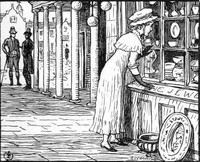
Midway through the excerpts, the narrative shifts to a story within the story: a girl named Nelly confesses to breaking her grandmother's china cup. The grandmother notices the shepherdess's dress has changed from 'pale pink or salmon-coloured skirt, looped up over a pea-green slip' to the reverse. Nelly, who secretly replaced the broken cup, bursts into tears: 'It was me, oh grandmother! It was me that changed the cup.' This confession scene echoes the earlier children's debate about grandmothers—now the test of a grandmother's goodness is not her manner but her response to a fault. The grandmother's arm encircles Nelly immediately, undercutting the girl's fear that she will never be loved again.
Several excerpts hinge on physical objects that carry hidden stories. The china cup with its metamorphosed shepherdess dress is the most elaborate: the grandmother describes dusting her 'best china' herself and noticing the change over two days. Earlier, the children's grandmother is associated with 'a wonderful box, full of every conceivable treasure and curiosity.' In the embedded tale, Nelly sits on a footstool at her grandmother's feet while listening to 'queer legends and fairy tales' from Scotland. These objects—a box, a cup, a footstool—anchor abstract moral lessons in tangible, often fragile things. Readers may watch for how later chapters use similar props to advance the plot or reveal character.
The catalog lists France as a setting, and the opening chapter's title 'Making Friends' suggests a new environment. The excerpts do not yet describe the French location in detail, but the grandmother's story mentions 'the far-away Scotch country place where her childhood was spent,' implying a contrast between the children's present home and the grandmother's past. The dedication is dated 'Maison Du Chanoine, October 1878,' a French address that may be the house where the story unfolds. Readers can note how the physical surroundings—whether a drawing-room with a forbidden cupboard or a garden under an apple-tree (hinted at in the illustration list)—shape the children's adventures and their relationships with the grandmother.
The excerpts move from a lighthearted sibling debate to a tense confession, linked by the theme of what makes a grandmother 'nice.' Mrs. Molesworth uses dialogue, framed narrative, and careful attention to objects to build a story that rewards close reading of small details. As you read, note how the children's initial impressions evolve, and whether the grandmother's own story—told in later chapters—mirrors or complicates the lessons Nelly learns.
I found myself thinking of the three siblings in Grandmother Dear, bickering until a quiet lesson unfolded, and somehow that led me to a memory of girls sharing a war-torn house with strangers, their small sacrifices stitched together by kindness. It wasn’t the plot that connected them, but that soft ache of growing up through care. I set The Outdoor Girls at the Hostess House; Or, Doing Their Best for the Soldiers — A Closer Reading beside it, and the afternoon felt gentler.
Save your reaction, strongest insight, and memorable passage.









