
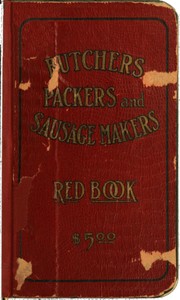
Butchers', Packers' and Sausage Makers' Red Book by George Jacob Sayer
Forget everything you think you know about dry historical texts. George Jacob Sayer's Red Book is something else entirely. Published in 1905, it was the essential handbook for anyone in the meat trade, from the small-town butcher to the large-scale packer. Sayer doesn't just tell you how to do the job; he shows you, with precise diagrams, meticulous instructions, and a no-nonsense approach that pulls zero punches.
The Story
There's no traditional plot with characters and dialogue. Instead, the 'story' is the journey of an animal from livestock to product. Sayer guides the reader through every single step. He explains different breeds of cattle and pigs, how to judge their quality while they're still alive, and the most humane and efficient methods for slaughter. Then, he dives deep into the craft: breaking down carcasses, identifying every cut of meat, and the science of preservation through curing, smoking, and sausage-making. The book is packed with recipes, blueprints for equipment, and advice on running a profitable business. It's a complete operational manual for a world that has largely vanished.
Why You Should Read It
I found this book absolutely gripping because of its sheer, unvarnished honesty. In our modern world, meat comes in clean, bloodless packages. This book removes that barrier. It forces you to confront the physical reality of where food comes from, not in a sensational way, but in a practical, matter-of-fact manner that our ancestors would have understood completely. Reading it gave me a profound appreciation for the skill and knowledge that was once common. The diagrams of pig anatomy are like a bizarre art project. The sausage recipes are a history lesson in flavor and preservation. It's humbling to see how much hands-on expertise has been lost to convenience.
Final Verdict
This is a niche book, but its appeal is wider than you'd guess. It's perfect for history nerds, foodies, and anyone curious about the lost arts of everyday life. If you love shows about how things are made, or if you're into homesteading or traditional skills, you'll devour this. It's also a fantastic resource for writers trying to add authentic detail to a historical setting. Just a heads-up: it's not for the squeamish. Sayer's clinical descriptions of slaughter and butchery are graphic by today's standards. But if you can look past that, you'll find a uniquely fascinating and insightful document that connects you to the gritty, skilled, and utterly real world of a century ago.
This digital edition is based on a public domain text. Feel free to use it for personal or commercial purposes.
James Lopez
7 months agoI found the author's tone to be very professional yet accessible, the formatting on mobile devices is surprisingly crisp and clear. This is a solid reference for both beginners and experts.
Mary Jackson
1 year agoClear, concise, and incredibly informative.
William Martin
3 weeks agoImpressive quality for a digital edition.
Donald Lopez
10 months agoI didn't expect much, but the content flows smoothly from one chapter to the next. Thanks for sharing this review.










Susan Brown
1 year agoClear, concise, and incredibly informative.